Why Your uPVC Door Handle Feels Stiff or Won't Lift
A stiff uPVC door handle or one that refuses to lift is almost always a sign of friction or misalignment inside the locking mechanism, not a broken handle itself. The most common cause is a multipoint lock that has shifted out of alignment, putting drag on the handle's internal cam. Before you assume the lock cylinder has failed, check the door's position relative to its frame: if the door has dropped or the hinges have settled, the handle will feel tight or won't lift at all. In many cases, a simple adjustment to the door's alignment restores normal handle operation without touching the lock itself.
uPVC doors rely on a multipoint lock system that engages several locking points along the door edge when you lift the handle. This design gives better security than a single-bolt lock, but it also means that even a small shift in the door's position can stop the handle from moving freely. The handle connects to a central gearbox inside the door, and when the locking keeps on the frame are no longer exactly level with the lock's hooks or rollers, the handle must overcome extra resistance. That resistance feels like stiffness, and if it is severe enough, the handle will not lift at all.
What Makes a uPVC Door Handle Stiff
The stiffness usually comes from one of three areas: the door alignment, the condition of the lock mechanism itself, or the handle assembly. Each has its own signs and a different fix.
Door Alignment
Over time, a uPVC door can sag under its own weight. The hinges wear, the frame may shift slightly, or the weather can affect the material. When the door drops even a couple of millimetres, the lock's hooks no longer line up cleanly with the keeps on the frame. The handle has to push the hooks past the keep edges, and that extra friction makes it feel stiff. You might also notice the door scrapes against the frame at the top or bottom, or that the gap between door and frame is uneven.
If the handle lifts partway and then jams, check the door's position when it is closed. Look at the gap at the top hinge side and compare it to the bottom hinge side. A visible difference means the door has dropped. The fix involves adjusting the hinges. Most uPVC door hinges have adjustment screws for height, lateral position and compression. A turn on the height-adjustment screw on the bottom hinge can lift the door back into alignment. This is a job that a competent DIYer can do with the right hex key, but if the door is very heavy or the screws are seized, a locksmith can handle it quickly.
Lock Mechanism Wear or Dirt
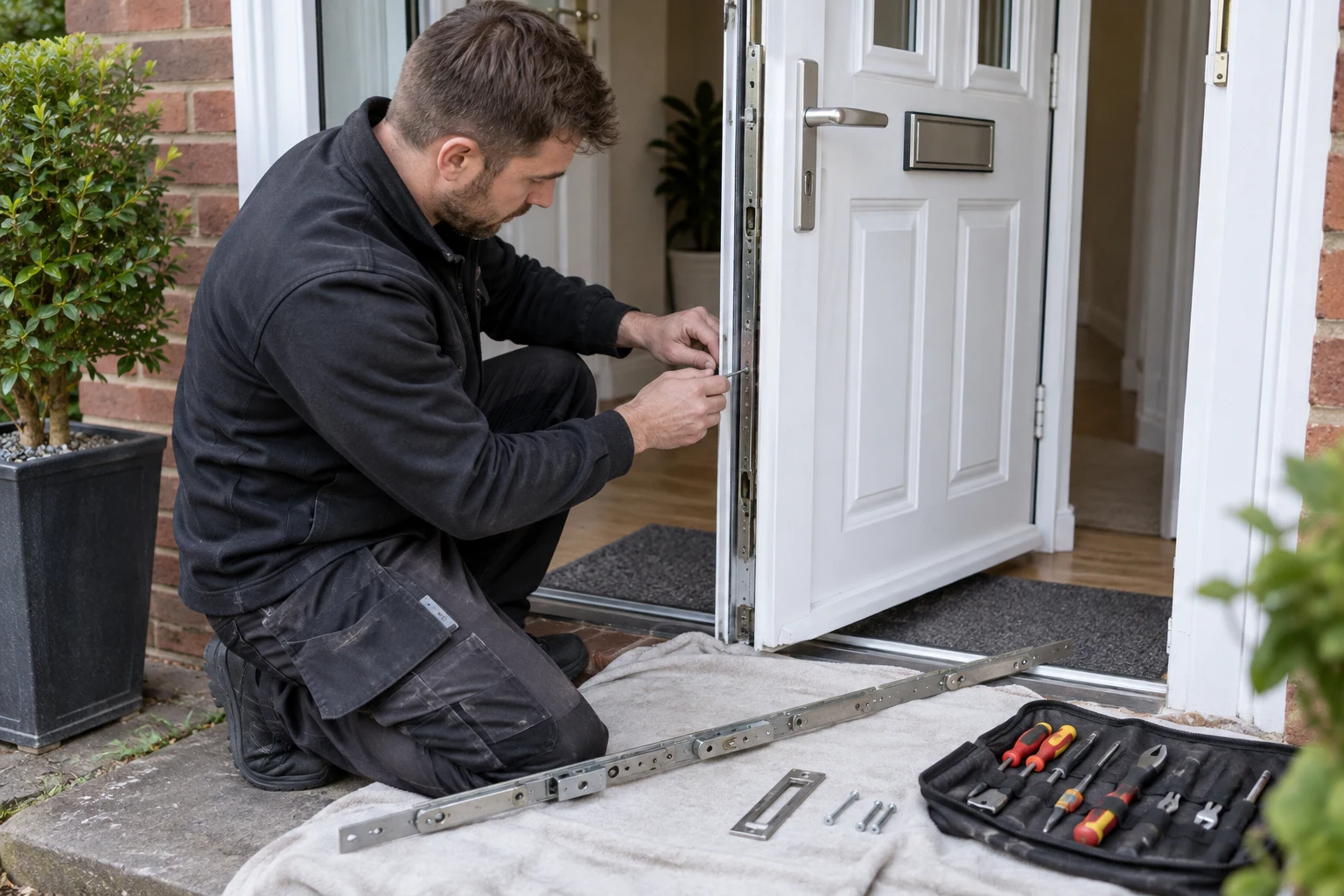
The multipoint lock gearbox contains moving parts: cams, springs and sliding bars. Over years of use, the grease inside can dry out, gather dust, or simply wear away. Dry metal-on-metal contact creates drag that the handle has to overcome. Dirt and grit from outside can also work its way into the mechanism through the key slot or around the handle spindle. This is especially common on doors exposed to rain and wind.
When the lock itself is the problem, the stiffness is usually consistent across the whole range of handle movement. It may feel gritty or slightly rough rather than just tight. Lubricating the lock can help, but it matters what you use. A silicone-based spray lubricant is safe for uPVC and the lock's plastic parts. Avoid oil-based lubricants or WD-40 as a general-purpose fix: they can attract dust and eventually make the problem worse. Spray the lubricant into the key slot and around the handle spindle, then operate the handle several times to work it in. If the stiffness does not improve, the gearbox may need professional attention or replacement.
Handle Assembly Problems
Sometimes the handle itself is the issue. A loose handle can rub against the backplate or the door surface. A handle that has been overtightened can pinch the spindle, creating friction inside the lock. If the handle feels stiff only when you lift it, not when you turn the key, the problem is more likely in the lock or alignment than in the handle. But if the handle feels stiff in both the up and down positions, or if it does not spring back to the horizontal position, the handle's return spring may be broken or the spindle may be bent.
Replacing a uPVC door handle is straightforward: unscrew the two screws under the trim caps, pull off the old handle, and fit the new one. Make sure the new handle has the same centre distance between the screw holes and the same spindle shape. If the stiffness disappears after a handle swap, the old handle was the culprit. If not, the problem runs deeper.
When the Handle Will Not Lift at All
A handle that refuses to lift completely is more worrying, but it still points to the same root causes. The most common scenario is that the door has dropped so far that the lock's hooks catch on the keep edges and cannot climb over them. You might be able to lift the handle a fraction of an inch before it stops. In this case, forcing the handle can damage the lock gearbox or snap the spindle. Stop trying and check the door alignment first.
Another possibility is that the lock cylinder itself is jammed. If the key will not turn fully, the handle may be blocked from moving. This can happen with a worn key, a broken key fragment inside the lock, or a lock cylinder that has seized due to dirt or corrosion. On a uPVC door with a security escutcheon, the cylinder may also be misaligned with the lock mechanism. A locksmith can remove the cylinder, inspect it, and either clean it or replace it. Anti-snap cylinders are common on modern uPVC doors and are designed to break at a weak point if forced, which adds security but can also leave the lock inoperable if the cylinder has been tampered with.
In colder weather, ice can form inside the lock or between the door and frame, freezing the handle in place. This is a temporary problem and usually resolves as the temperature rises. Never pour hot water on a frozen lock: the sudden temperature change can crack the cylinder or warp the uPVC. Use a dedicated lock de-icer or a gentle heat source like a hairdryer on a low setting.
How to Diagnose the Problem Yourself
Before calling a locksmith, you can run through a quick check to narrow down the cause. Open the door and try the handle. If it moves freely with the door open but stiffens when the door is closed, the problem is alignment or the keeps. If it is stiff in both positions, the issue is in the handle or the lock gearbox.
With the door open, look at the locking points along the edge. They should all move in and out smoothly when you lift the handle. If one or two stick, the gearbox may be failing in that area. You can also check the keeps on the frame: they should be clean and free of paint or debris that might block the hooks. A small file can clean up a painted-over keep, but be careful not to remove too much metal.
If the door alignment seems off, try lifting the door slightly at the handle as you close it, then attempt to lift the handle. If it works, the door has dropped. This is a temporary test, not a fix, but it confirms the source.
When to Call a Professional
A stiff handle that will not lift is a security concern because it can stop you from locking the door properly. If the handle is stuck in the lifted position (the locked position), you may not be able to open the door from the outside without a key, or you may be locked out entirely. A locksmith can adjust the door alignment, repair or replace the multipoint lock gearbox, and fit a new handle or cylinder if needed. For anyone in the Cannock area, a service such as arrivalocksmiths.co.uk can respond to these issues quickly, whether the problem is a simple hinge adjustment or a full lock replacement.
If the door alignment is the only issue and you are comfortable with basic tools, adjusting the hinges is a reasonable DIY task. However, if the lock mechanism itself is damaged or the handle will not move at all, it is safer to let a professional handle it. Forcing a seized lock can break internal parts and leave the door unopenable, which then requires drilling out the cylinder or cutting the door open - both more expensive than a call-out.
Regular maintenance helps prevent stiffness. Clean the door tracks and keeps twice a year, lubricate the lock mechanism with silicone spray, and check the hinges for tightness. If you notice the handle starting to feel slightly stiff, address it early before it becomes a full jam. A small adjustment now can save you a lockout later. For reliable support with uPVC door lock issues, a local locksmith like arrivalocksmiths.co.uk offers services across domestic and commercial properties, covering 24-hour emergencies as well as planned repairs.

Key Operation and Lock Cylinder Issues
The relationship between the key and the handle is important. On a multipoint lock, the key usually operates the cylinder, which retracts the main bolt and also allows the handle to lift the other locking points. If the key is hard to turn or will not go in fully, the cylinder may be the cause of the handle stiffness. A worn key can be replaced easily. A seized cylinder may need to be lubricated or replaced. Security escutcheons are designed to protect the cylinder from drilling and picking, but they can also trap dirt and moisture against the cylinder, accelerating wear. A good quality anti-snap cylinder resists forced entry and is worth fitting if your current cylinder is old or problematic.
If the key turns smoothly but the handle remains stiff, the cylinder is not the problem. Focus on the door alignment and the gearbox instead. In rare cases, the lock's internal spring that returns the handle to the horizontal position can break. When this happens, the handle will flop down and may not lift properly. Replacing the gearbox is the only cure for a broken spring, as the spring is not a user-serviceable part.
Understanding why your uPVC door handle feels stiff or will not lift helps you decide whether you can fix it yourself or need a professional. Most cases are alignment-related and simple to correct. A few are lock mechanism failures that require specialist tools and knowledge. Either way, the problem is almost never a mystery: it is friction, misalignment or wear. With the right diagnosis, you can get your door working smoothly again.